


Juan Ballesteros
Juan R. Ballesteros Sánchez (UPO) is a Professor of Ancient History in the Department of Geography, History and Philosophy and a specialist in mediaeval and modern historiography on Antiquity. His studies range from classical historiography to the humanistic approach to Antiquity. Recently, he is the author of a critical edition of Iustus Lipsius’ Admiranda (1598). He has also studied the tradition of classical authors such as Aelius Aristides, Martial, and the Historia Augusta in monographic publications. Now he is interested in detecting and studying the ways of quoting, reading and adapting Greek and Latin sources. His goal is to present the General Estoria as a neoclassical experience and the classical elements recovered and employed by the General Estoria team in fields such as Geography, Astronomy, Ethnography or Linguistics.
Juan Ballesteros
Co-Applicant


Maite Caro
Graduated in Geography and History from Pablo de Olavide University in Seville. She subsequently completed a Master's Degree in Egyptology and Oriental Studies at the University of Pisa, where she studied Middle Eastern languages such as Egyptian, Akkadian, Ugaritic, and Syriac.
Contact: mcaro2999@gmail.com
Maite Caro
Graduate Student
Juan Manuel Cortés Copete
Juan Manuel Cortés Copete is Professor of Ancient History, Universidad Pablo de Olavide, Sevilla. He is an expert in Roman History and Greek Literature in the Roman Empire, with a particular emphasis on the Second Sophistic. He is also interested in the Jews under Roman rule. His most recent research has to do with the unity and diversity in the Roman Empire, and with the formation of a new social identity for the Empire.
Juan Manuel Cortés Copete
Collaborator


Juan Héctor Fuentes
Juan Héctor Fuentes is a professor with a bachelor’s degree and a Ph.D. in Literature from the University of Buenos Aires (UBA) and a master’s degree in Hispanic Philology from the Institute of the Spanish Language (CSIC, Madrid).
He works as an independent researcher at IIBICRIT - SECRIT (CONICET), an institution he joined in 1992, and is a professor of Latin Philology and History of the Spanish Language in the School of Philosophy and Letters at the University of Buenos Aires. He serves as director and co-director of several doctoral and master’s theses. He conducts research on ecdotics and translation in projects based in Argentina and Spain.
He is the author of numerous articles and book chapters published in Argentina and abroad, focusing particularly on issues of textual criticism, medieval lexicography, and the phenomenon of translation and the dissemination of the classics during the Middle Ages and early modern period.
Contact: juanhectorfuentes@gmail.com
Juan Héctor Fuentes
Collaborator


Lúa Blanca Garea Garrido
Lúa Blanca Garea Garrido received her BA in Classical Philology from the University of Santiago de Compostela, where she is currently a Ph.D. candidate supported by a predoctoral fellowship funded by the Xunta de Galicia (ED481A). Her doctoral dissertation focuses on the scientific learning and intellectual culture of the mendicant orders in the thirteenth-century Santiago de Compostela, with a particular focus in the study and translation of the works of Bishop Pedro Gallego. She has participated in and organized different national and international conferences and seminars and has completed two research stays, one at SISMEL (Florence, Italy) and another at the Warburg Institute (London, United Kingdom). She is also a member of the working group for the Spanish research project “LETRA. Lectura, comentario y traducción de autores clásicos en la Edad Media hispánica: estudio, edición y catálogo”.
Lúa Blanca Garea Garrido
Graduate Student


Miguel Giadás Quintela
Miguel Giadás Quintela is an Assistant Professor of Latin Philology in the Department of Classical, French and Italian Philology at the University of Santiago de Compostela (USC), where he has been a faculty member since September 2025. He holds a Bachelor’s Degree in Classical Philology (2016) and a Master’s Degree in Secondary Education Teacher Training (2017), both from the University of Santiago de Compostela. In 2023, he earned his PhD from the same institution through the Doctoral Programme in Classical Antiquity Texts and Their Legacy with a dissertation entitled As Cronice ab origine mundi of Gonzalo de Hinojosa (Books I–IV): Study and Edition. His research focuses on medieval Latin historiography in the Iberian Peninsula, with particular emphasis on Gonzalo de Hinojosa’s Cronice ab origine mundi and its textual sources. He has published in leading peer-reviewed journals, presented his research at numerous international conferences, and undertaken research stays at the École Normale Supérieure de Lyon and Columbia University.
Miguel Giadás Quintela
Collaborator

José Manuel Luque Romero
José Manuel Luque Romero graduated at the University of Seville where he also studied as a postgraduate level at the University of Seville; he then completed his second master’s degree at the University of Lyons II on the figure of Cléon. After several years of research on the political discourses in the works of Herodian and Cassius Dio, he became a history and geography teacher working for the French Department of Education, where he still works today. Since 2022, he has been preparing a bilingual edition of Eusebius’ Chronicon as a PhD under the supervision of Juan Manuel Cortés Copete.
José Manuel Luque Romero
Graduate Student


Antonio Rubio Martínez
Antonio Rubio Martínez is a PhD student in the Spanish, Italian and Portuguese Department at Penn State University. He holds a degree in Literature and Creative Writing from the Universidad de Navarra (2018-2022), where he also studied History. He then completed the Spanish M.A. at the University of Wisconsin-Milwaukee (2022-2024) and in Penn State University (2024-2026). In 2026, he participated in the scholarly program, A Folder Orientation to the Research Methods and Agendas at the Folger Institute where he developed bibliographical and book-description skills, digital image practices, and understanding of texts, sources, collections, and access tools. He will focus his doctoral thesis research on the interplay of the Spanish Golden Age theater and the Spanish Medieval history. Specifically, he is interested in the portrayal of succession conflicts in historical comedias and how these events are used to discuss political ideas concerning monarchy and the role of royalty in seventeenth century societies.
Contact: axr6220@psu.edu
Antonio Rubio Martínez
Graduate Student

Nicolás Solari Jarque
Degree in Classical Philology (2017) at the Complutense University of Madrid, Master in Written Historical Heritage (2018) at the Complutense University of Madrid and PhD in Latin Linguistics (2022) at the University of Alcalá.
During the period of his doctoral training he received a grant from the Hugo Schuchardt Foundation of the University of Graz (Austria) and published a large corpus of the Preposition + Adjective adverbial patterns on which his research was focused within the research international project The Third Way, of which he was part as a pre-doctoral researcher.
His line of research focuses on Latin adverbs, especially adverbial formations of preposition and adjective, approaching this topic from diachronic, morphological and semantic perspectives.
Nicolás Solari Jarque
Collaborator

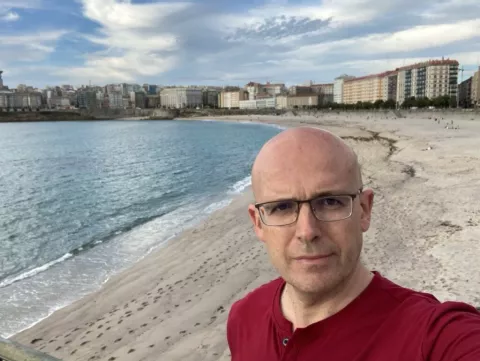
Juan Udaondo Alegre
JUAN UDAONDO ALEGRE is an Associate Professor of Spanish and Classics and Ancient Mediterranean Studies at Penn State University. His research focuses on Classical, Semitic, and Ancient Near Eastern traditions that are at the foundations of Iberian culture. His recent book, The Spanish Hermes and Wisdom traditions in Medieval Iberia: Alfonso X’s General Estoria (Durham University IMEMS Press / Boydell and Brewer 2024), explores the Castilian rendering of Hermes Trismegistus, a Hellenistic conflation of the Greek Hermes (god of interpretative wisdom) and the Egyptian Thoth (god of wisdom), who was considered by many in the medieval world as the father of culture. In this book and other recent articles, Professor Udaondo Alegre unveils the pivotal role of King Alfonso X (“the Learned”) of Castile (1252-84) in creating this Spanish Hermes. Dr. Udaondo has also authored publications on Spanish Golden Age theatre and playwrights such as Lope de Vega and Calderón de la Barca.
Contact: jpu105@psu.edu
Juan Udaondo Alegre
Co-Applicant and Team Coordinator