


Mahmoud Mohammed Abdelrahim
Degree in Hispanic Linguistics and Literature (2008), Assistant Professor of Teaching and Research in the Department of Spanish (2012), at the Al-Azhar University (Cairo). At the same university he completed two years of Advanced Studies in Spanish Linguistics (2014) at the Faculty of Languages and Translation. She holds a Career Certificate in Teaching Arabic as a Foreign Language from the American University (Cairo). He has taught Arabic at the Toledo School of Translators (2015) and completed postgraduate studies at the University of Granada (Master’s Degree in Professional Translation, 2016). Since 2018 he has been a doctoral researcher at the Pablo de Olavide University (Seville). In 2019 he obtained the title of Specialist in Arabic-Spanish Translation.
Mahmoud Mohammed Abdelrahim
Collaborator


Yasmine Beale-Rivaya
Dr. Yasmine Beale-Rivaya is a Professor of Spanish Linguistics at Texas State University. Her research centres on language contact, change, and borrowing in borderland communities of Medieval Iberia. Working with multilingual primary resources, Yasmine focuses on evidence of language practice, contact, and interchange between multilingual communities and multifaceted peoples such as the Mozarabs (Arabized-Christians), Mudejars (Christianized-Muslims), and Moriscos (Muslim Converts) living along borderland areas in Medieval Iberia and by-products resulting from this contact. Dr Beale-Rivaya compares the linguistic experiences of these multilingual communities in the Medieval Mediterranean to those of Spanish-speaking or people of Spanish linguistic heritage along borderland communities between the US and Mexico. These two lines of research have led her to think about patterns of minorization and linguistic segregation from a broader perspective. This work has resulted in securing the NEH Distinguished Professorship in Teaching in the Humanities (2021-2024) and the development of the digital humanities project titled Minority and Minoritized Languages and Cultures. The open education resource digital project maps, describes, and catalogs contemporary minoritized languages in order to bring more attention to lesser-known languages in an approachable manner.
Yasmine Beale-Rivaya
Co-Applicant


Bárbara Boloix-Gallardo
Bárbara Boloix-Gallardo is Senior Lecturer of Arabic and Islamic Studies at the University of Granada (Spain). She conducted her post-doctoral research period at Washington University in St. Louis (Missouri, USA), where she taught courses on History of al-Andalus. Her main area of specialization is the History, Society, and Culture of al-Andalus and the Maghreb, in particular the study of the Nasrid Kingdom of Granada (13th–15th centuries) and the study of both Andalusi and Maghribian women. She has directed two National Research Projects on “Nasrid
and Merinid Women in the Islamic Societies of the Medieval Mediterranean
(13th–15th centuries): Power, Identity, and Social Dynamics” (HAR2017-88117-P) and “From Nasrid to Morisco Women: Daily Lives, Influences, and socio-cultural (dis)continuities in the inner-history of the peninsular context (13th–16th centuries)”, respectively.
She has delivered a number of papers at international conferences and prepared several publications on these topics. Among them are the book “Las Sultanas de la Alhambra. Las grandes desconocidas del Reino Nazarí de Granada (siglos XIII–XV) (2013)” and the edition of the monography “A Companion to Islamic Granada” (Brill, 2021).
She is currently a Member of the University Institute of Research on Women and Gender at the University of Granada and Vice-Secretary of Cultural and Institiutional Cooperation at the Euro-Arab Fundation in Granada.
Bárbara Boloix-Gallardo
Co-Applicant


Alejandro Colete
Lecturer at CIEE (Seville) of Polisitics and Society in Contemporary Arab World. PhD in history of Islamic Science and Philosophy (University of Seville, 2021). Master’s Degree in Narrative and Script-writing (2017), and BA in Philosophy (2015). Devoted polyglot (English, German, Arabic, Turkish, Latin, Hebrew, Greek), translator for private business, editor, draughtsman, content creator and film-maker. His doctoral dissertation dealt with the legacy of Late Antiquity in Islamic Science and Philosophy, topic I adressed through the framework of Wittenstein’s philosophy of language. My research focused in the conception of knowledge and its evolution from Antiquity to Late Antiquity. I worked as much as possible with the documents in their original languages (Ancient Greek, Latin, Arabic, Syriac), working with grammar books as much as with the text themselves. His methodolgical approach required thorough knowledge of the grammar of both semitic and indo-european languages, in order to compare exactaly how ideas or concepts were being put into words.
Research interests
Late Antiquity, History of Science and Philosophy, Turkic Studies, Contemporary Islamic World, Middle East, Literature, Antiquity, Polyglotism, The Silk Road, Political Philosophy, Art History, Indo-European Studies, Modern History, Language
Alejandro Colete
Collaborator


María Crego
María Crego is a professor of Arabic language and culture and Arabic-Spanish translation at the Pablo de Olavide University (UPO) in Seville. She received her PhD in Arabic Philology from the University of Granada and is a Specialist in Arabic-Spanish Translation from the Toledo School of Translators. She completed her doctoral thesis at the School of Arabic Studies (CSIC) in Granada.
Her main fields of study are the History and Historiography of al-Andalus and the transmission of knowledge between the Arab-Islamic and Christian worlds. She works specifically on the influence of oriental texts on Spanish historiography and literature, as well as on the medieval genre of Arabic biographical dictionaries, both Andalusian and Maghrebi. She is the author of the monograph Toledo en época Omeya (ss. VIII-IX).
María Crego
Collaborator


Mahmoud Emam
Emam, Mahmoud Ahmed Mahmoud – Bachelor’s degree in Hispanic Philology (2012) from Al-Azhar University (Egypt), postgraduate studies at the University of Salamanca (Master’s Degree in Hispanic Language and Culture) (2014-2016) and PhD in Foreign Languages and Literatures (Spanish Philology) from the Università degli studi di Verona with co-direction from the University of Granada (2023). He has taught teaching support classes for the courses Introduction to Spanish Linguistics, Spanish Varieties II, Spanish Language III at the Università degli studi di Verona (2023). Currently, he is a lecturer in the Department of Spanish Language at Al-Azhar University (Egypt). He has experience in teaching Spanish as a foreign language in Egypt. He has participated in different projects of translation of books from Arabic into Spanish and vice versa, as well as in the compilation of specialized Spanish-Arabic and Arabic-Spanish lexicographical works. His lines of research focus on the study of lexical repertoires, lexicology, lexicography and applied linguistics, and on the relations that these establish with other Semitic (Arabic) and Romance (Italian) languages. He has participated in the project “PRIN: Un nuovo ambiente digitale per il recupero del patrimonio lessicografico: il Tesoro digitale della lessicografia bilingue spagnolo-italiano”. He has published some works on phraseology and bilingual Spanish-Arabic and Arabic-Spanish lexicography in journals and monographs of recognized international prestige in the field of philological studies.
Mahmoud Emam
Collaborator


Anas Ghrab
Following his studies in music and musicology (University Lyon 2), he obtained his PhD from the University of Paris-Sorbonne. Former director of the Center for Arab and Mediterranean Music (Ennejma Ezzahra Palace), he now teaches at the University of Sousse (Higher Institute of Music). He is also a researcher at the L3S laboratory (ENIT), associate researcher at IreMus (Paris), regional representative of the ICTM, and leads several interdisciplinary projects related to digital arts and humanities, in particular the Musée du Patrimoine Écrit, in collaboration with the National Library of Tunisia and the Tunisian Academy Beït al-Hikma-Carthage.
Anas Ghrab
Co-Applicant


David Porcel Bueno
Degree in Hispanic Philology (2009), Romance Philology (2011) and Arabic Philology (2014) from the University of Granada, and Degree in Hebrew Philology (2016) from the Complutense University of Madrid, he completed postgraduate studies in the University of Granada (Masters in Classical Philology) and is a doctor in Spanish Philology from the University of Valencia (2015). He is currently finishing his second doctoral thesis in Galician-Portuguese Philology at the University of Santiago de Compostela. He has been a postdoctoral researcher at the University of Heidelberg, at the Paris-Sorbonne University (Paris IV), at the University of Oxford and at the University of Bologna, and has been visiting professor at the Universities of Graz, Kassel, Rostock, Montreal, Verona, Padua, Belgrade, among others. He is currently a Assitant Professor in the Department of Philology: Romance, Italian, Galician-Portuguese and Catalan, at the University of Granada. His lines of research focus on the study of Ibero-Romance languages and literatures, especially in their medieval and classical phase, and on the relationships they establish with other Iberian (Arabic, Hebrew and Medieval Latin) and Romance languages and literatures (Italian, Occitan and French). He has participated in six international research projects and has published numerous papers on diachronic Romance linguistics and medieval Romance literatures in internationally renowned journals and monographs in the field of philological studies.
David Porcel Bueno
Co-Applicant and Team Coordinator

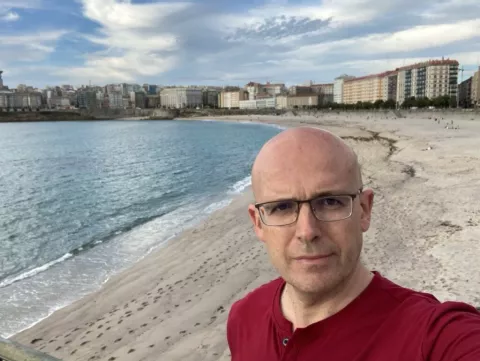
Juan Udaondo Alegre
JUAN UDAONDO ALEGRE is an Associate Professor of Spanish and Classics and Ancient Mediterranean Studies at Penn State University. His research focuses on Classical, Semitic, and Ancient Near Eastern traditions that are at the foundations of Iberian culture. His recent book, The Spanish Hermes and Wisdom traditions in Medieval Iberia: Alfonso X’s General Estoria (Durham University IMEMS Press / Boydell and Brewer 2024), explores the Castilian rendering of Hermes Trismegistus, a Hellenistic conflation of the Greek Hermes (god of interpretative wisdom) and the Egyptian Thoth (god of wisdom), who was considered by many in the medieval world as the father of culture. In this book and other recent articles, Professor Udaondo Alegre unveils the pivotal role of King Alfonso X (“the Learned”) of Castile (1252-84) in creating this Spanish Hermes. Dr. Udaondo has also authored publications on Spanish Golden Age theatre and playwrights such as Lope de Vega and Calderón de la Barca.
Contact: jpu105@psu.edu
Juan Udaondo Alegre
Co-Applicant and Team Coordinator